
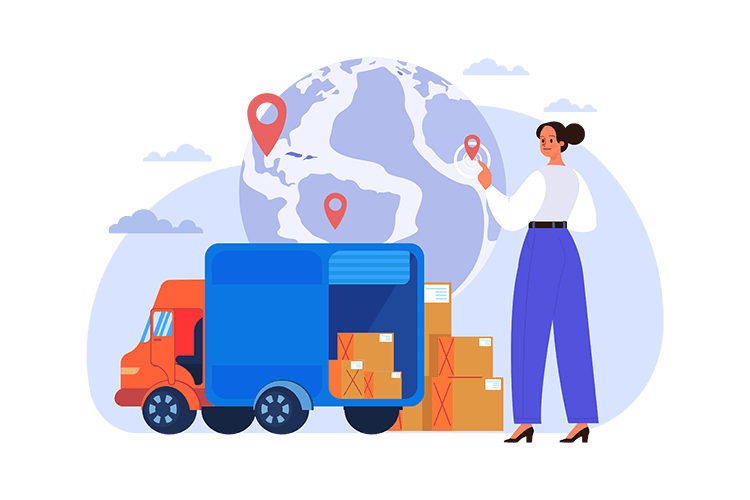
CDN (Content Delivery Network) is a distributed system consisting of servers located at over 100 points worldwide. By using this structure in services provided to you such as web hosting, you will have fast access as data will be accessed from the location closest to you, while also minimizing the impact of outages in different locations on you and your customers.
A CDN (Content Delivery Network) is a geographically distributed network of servers that enables you to deliver your website’s content, such as HTML, images, videos, CSS and JavaScript, from the point closest to the user by caching them on globally positioned servers.
A CDN is not a hosting service and does not replace your existing hosting infrastructure; it positions itself in front of it to cache content at the edge of the network. When a user wants to access content, the data is sent from this edge point closer to the user rather than the origin server whenever possible; thus, a shorter distance is traveled, loading time is shortened and the traffic load on the origin server is reduced.

Although the benefits of using a CDN service vary depending on the size of your site, the main effects are grouped under the following headings
Content is served from the edge point closest to the visitor; load time is shortened, the bounce rate decreases and visitors stay on the site longer.
Since requests are handled by edge servers, the amount of data the origin server needs to provided and consequently hosting, cost decrease.
Thanks to load balancing and smart failover, traffic spikes and hardware failure do not affect your website's availability.
If an issue occurs in a data center, Anycast routing automatically transfers traffic to another CDN point to maintain access.
With up-to-date TLS/SSL certificates and DDoS mitigation measures, malicious traffic is blocked at the edge of the network before reachingthe origin server.
The traffic load on the main server is alleviated by handling the majority of cacheable requests from edge points.
The user rewuest is routed to the nearest possible CDN point, and the content is delivered from the most efficient source.
The browser or application creates its request for web content.
The request is routed to the appropriate edge location based on geographical and network conditions.
If the content is available on the edge, it is delivered to the user wihtout going to the origin.
The most frequently wondered technical and operational issues befor e switching to the CDN service.
The CDN service is a Content Delivery Network service that enables web content to be cached at distribution points located in different geographical regions and delivered to the user from a server closer to them.
Yes. Content is served from an edge server geographically closer to user; this shortening of the distance reduces latency. In addition, load balancing, file compression and TLS/SSL connection optimization also increase page load speed.
No. A CDN is not a hosting infrastructure; it positions itself in front of it to cache content at the edge of the network. The appropriate integration method is determined based on your hosting and DNS structure.
Static files such as HTML pages, images, CSS, JavaScript, fonts documents and the like are common use cases. Dynamic content and custom caching rules are planned according to the application structure.
Yes. Since a CDN is positioned at the edge of the network, it can detect and block much malicious traffic, including DDoS attacks, before it reached the origin server and it also increases data security with up-to-date TLS/SSL certificates.
No. Although the most obvious benefit is seen on sites with high global traffic, sites of any scale with a dispersed visitor base can benefit from a CDN; it provides consistent performance independent of user location and an additional layer of security.
Pricing is shaped by variables such as traffic volume, geographical distribution, content type, cache ratio and technical requrements. A custom quote is created for enterprise needs.
Technically, a CDN can be configured to work with different origin infrastructures. Suitability and the integration method are determined after examining yout existing system.
Contact us now, let’s provide the most suitable solution for your organization.
Hilal Mh. Cezayir Cd. No:15/A Çankaya Ankara / Türkiye
0312 472 22 33 | 0850 303 VRYM
0850 200 21 76
Cevdet KAYMAZ
Atatürk Bul. Hacı Hanife İş Merkezi No: 120/12 Odunpazarı Eskişehir / Türkiye
Burhan KAYMAZ
Seğmenler Vergi Dairesi - 924 047 65 78
321915
2/2307
Bilgi Teknolojileri ve İletişim Kurumu